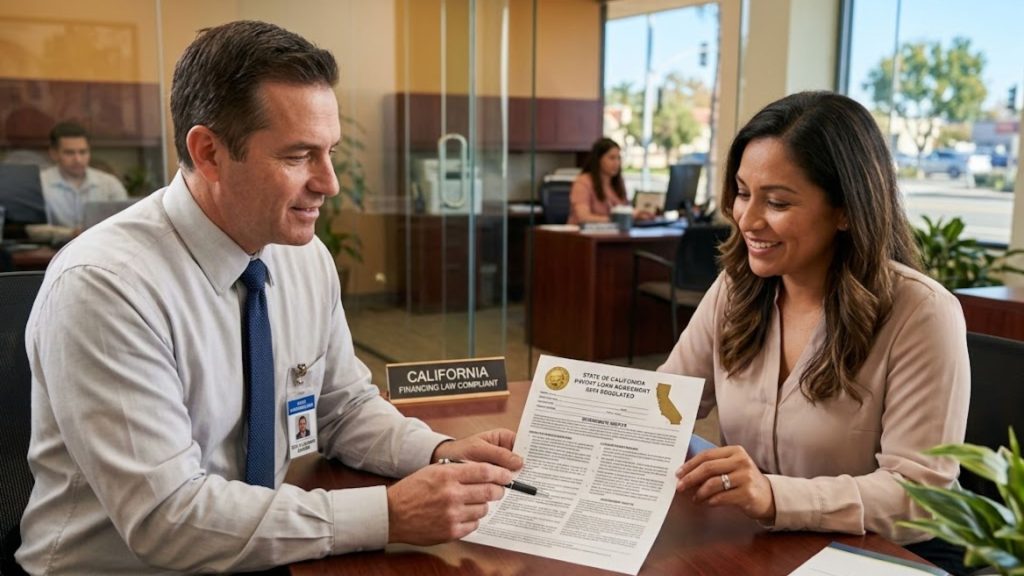
Understanding California payday loan laws helps borrowers know exactly what to expect: how fees are structured, what lenders can and cannot do, and what protections are in place. California law caps loan amounts at $300, sets a flat $15-per-$100 fee, and prohibits rollovers and refinancing. The California Department of Financial Protection and Innovation (DFPI) oversees and enforces these rules. For returning customers of California Online Loans in good standing, the customer portal and mobile app deliver instant approval and instant funding 24⁄7 — any time of day or night. First-time funding: minutes via debit-card if your bank supports it, or 1–2 days via ACH otherwise.
Key Takeaways
- California caps payday loans at $300 (face value / total repayment).
- Fee structure: flat $15 per $100 borrowed — see fee table below. No origination fees, no late fees, no application fees.
- 460% APR applies to a two-week loan at the $15-per-$100 fee. APR is annualized; the actual dollar cost on a $300 loan is $45.
- Loan term: 1 to 31 days, single payment on the agreed due date.
- No rollovers. No refinancing. Each loan must be paid in full before a new loan can be issued.
- Returned check fee: up to $15. That is the only fee that applies to a missed payment.
- No credit check. No bureau reporting.
- Eligibility: at least 18 years old, California resident, active bank account, verifiable income from any documentable source — see Eligibility below.
- First-time funding: minutes via debit-card if your bank supports it, or 1–2 days via ACH otherwise. Returning customers in good standing: instant 24⁄7 via the portal or app.
- The DFPI enforces licensing, fee disclosures, and fee limits for all California payday lenders.
Legal and Regulatory Requirements
California’s regulatory framework establishes clear limits and disclosure standards for payday lending. The law caps loans at $300, sets the fee at $15 per $100 borrowed, requires full disclosure of fees and repayment terms before signing, and prohibits rollovers and refinancing. These rules apply to every licensed payday lender in the state.
Consumer Protections
California law includes specific protections to ensure transparent terms and fair treatment:
- Fee cap: $15 per $100 borrowed, flat. No origination fees, no late fees, no application fees.
- Loan cap: $300 maximum per loan.
- No rollovers or refinancing: Each loan must be paid in full before a new loan can be issued.
- Disclosure requirement: Lenders must present all fees and repayment terms clearly before the borrower commits.
- Returned check fee cap: Up to $15 — the only fee that applies to a missed payment.
- No harassment: Borrowers are protected from aggressive or abusive collection practices.
What Are the Key California Payday Loan Laws Regulating Lending Practices?
Several statutes govern payday lending in California. Together they set loan size limits, cap allowable fees, and require transparent disclosures:
- Loan amount limit: Payday loans are capped at $300.
- Fee structure: The maximum fee is $15 per $100 borrowed, flat — this is a fixed fee, not accruing interest.
- Loan term: 1 to 31 days, single payment on the agreed due date.
- Disclosure requirements: Lenders must provide clear information about loan terms, fees, and repayment schedules before the borrower signs.
- No rollovers or refinancing: Prohibited under California law.
How Does the DFPI Enforce Payday Lending Rules in California?
The DFPI enforces California payday lending laws through licensing, examination, and enforcement actions. The DFPI reviews lender practices, conducts audits and investigations when warranted, and imposes penalties for violations. This oversight ensures lender compliance and consistent consumer protections across the state.
What Licensing Requirements Must Payday Lenders Meet in California?
Payday lenders must obtain and maintain a DFPI license to operate lawfully in California. The licensing process requires detailed business information and evidence of compliance systems. The DFPI evaluates applicants for financial stability and adherence to state statutes. Only licensed, regulated entities may offer payday loans in California.
- Licensing process: Lenders apply for a license and provide detailed information about business operations.
- Eligibility criteria: Lenders must demonstrate financial stability and compliance with state laws.
- Compliance standards: Lenders must adhere to all regulations on loan amounts, fees, and consumer protections.
What Are the Fee Limits and Repayment Terms for California Payday Loans?
California sets a flat fee of $15 per $100 borrowed. The loan term runs from 1 to 31 days — repayment is due in full on the agreed date. Here is how fees and amounts work at each loan size:
| Loan Amount (Face Value / Total Repayment) | Fee | Amount Received | APR (2-week loan) |
| $100 | $15 | $85 | 460% |
| $200 | $30 | $170 | 460% |
| $300 | $45 | $255 | 460% |
Example: A $300 loan carries a $45 fee. The borrower receives $255 and repays $300 on the due date. The 460% APR applies to a two-week loan; it is the annualized form of the $45 flat fee and does not reflect a growing or accruing cost.
Which Fees Are Permitted Under California Payday Loan Regulations?
California permits only the following fees:
- Loan fee: $15 per $100 borrowed, flat. For a $300 loan, this is $45.
- Returned check fee: Up to $15, charged only if a payment is returned.
No origination fees. No late fees. No application fees. No processing fees. All fees must be disclosed in the loan agreement before signing.
How Are Single-Payment Advances Structured Without Accruing Interest?
Single-payment advances in California use a fixed fee model. The fee is set at origination based on the loan amount and does not change over the loan term. There is no accruing interest and no compounding — the borrower knows the exact repayment amount at signing and that amount stays the same until the due date.
What Borrower Rights and Protections Does California Law Provide?
California law grants borrowers clear rights throughout the loan process:
- Full disclosure: Borrowers must receive clear information about all fees and terms before signing.
- No rollovers: Borrowers cannot be required to roll over or refinance a loan. Each loan must be paid in full before a new one can be issued.
- No harassment: Borrowers are protected from aggressive or abusive collection practices.
- Regulatory oversight: The DFPI monitors lender compliance and accepts consumer complaints.
How Does California Protect Borrowers from Excessive Fees and Practices?
California protects borrowers by enforcing the $300 loan cap, the $15-per-$100 fee cap, and mandatory fee disclosures. The prohibition on rollovers and refinancing means each loan is a clean, single-payment transaction. The DFPI monitors compliance and acts against lenders who violate these rules.
What Are Borrowers’ Rights Regarding Loan Repayment and Default?
Lenders must communicate repayment obligations and consequences for non-payment clearly. Borrowers are protected from harassment. If you need more time to repay, California Online Loans grants up to 5 days extension on request, with no fee, to customers in good standing. You sign a new due date acknowledgement through the customer portal confirming the updated payment date — no formal extension contract required.
- Clear communication: Lenders must explain repayment terms and any consequences of non-payment.
- No harassment: Borrowers are protected from aggressive collection practices.
- Extension option: California Online Loans grants up to 5 days extension on request, no fee, through the customer portal.
How Do Instant Funding Payday Loans Operate Within California’s Legal Framework?
Instant funding payday loans in California are subject to the same $300 cap, $15-per-$100 fee limit, and disclosure requirements as standard payday loans. The difference is speed of disbursement. For first-time applicants, funding lands in minutes via instant debit-card transfer if your bank supports it, or in 1–2 days via ACH otherwise. Returning customers in good standing receive instant approval and instant funding 24⁄7 through the portal or mobile app — no wait required.
What Is the Process for Same-Day Funding of Payday Loans in California?
- Application submission: Submit the online application with required personal and income information. Applications can be submitted 24⁄7.
- Approval process: Approval decisions happen during business hours (Monday–Friday 5:00 AM–10:00 PM PST, Saturday 6:00 AM–8:00 PM PST, Sunday 8:00 AM–8:00 PM PST).
- Fund disbursement: Once approved, funds land in minutes via instant debit-card transfer if your bank supports it, or in 1–2 days via ACH otherwise.
Returning customers in good standing bypass the standard approval queue entirely — instant approval and instant funding, 24⁄7, through the portal or mobile app.
How Does 24/7 Customer Portal Access Enhance Borrower Control?
California Online Loans provides a 24⁄7 customer portal and mobile app for complete account management. Returning customers in good standing can apply and receive instant funding at any hour — manage short-term cash needs on your own schedule, without waiting for business hours.
- Instant application processing: Returning customers in good standing receive instant approval and instant funding 24⁄7.
- Payment management: Track payment schedules, make payments, and view outstanding balances online.
- Account information: Access loan details, repayment terms, and payment history at any time.
- Extension requests: Request your up-to-5-day extension through the portal before your due date — no fee, just a new due date acknowledgement.
- Customer support: Contact the team at any time through the portal for assistance.
How Do California Payday Loans Compare to Personal Loans Under State Law?
Payday loans and personal loans differ in size, term, and cost structure. Here are the key distinctions:
- Loan size: Payday loans are capped at $300. Personal loans can cover larger amounts.
- Term: Payday loans are single-payment, due within 1–31 days. Personal loans offer longer repayment schedules.
- Fee vs. interest: Payday loans charge a flat fee ($15 per $100). Personal loans charge interest that varies and accrues over the repayment period.
- APR: Payday loans carry a higher APR (460% for a two-week loan). Personal loans carry lower APR but involve interest accruing over months.
- Credit check: California Online Loans does not run credit checks. Personal loans generally require one.
- Processing time: Payday loans can fund in minutes or 1–2 days. Personal loans involve more documentation and longer processing.
What Are the Advantages of Payday Loans Over Personal Loans in California?
For urgent, short-term cash needs up to $300, payday loans offer speed and accessibility that personal loans cannot match:
- Quick access to funds: Approved and funded in minutes (debit-card) or 1–2 days (ACH). Returning customers in good standing: instant 24⁄7.
- No credit check: California Online Loans does not run credit checks. Credit history does not affect approval.
- Simplified application: Minimal documentation required, online process.
How Do Fee Structures and Terms Differ Between Payday and Personal Loans?
Payday loans use a fixed flat fee tied to the loan amount — $15 per $100, known upfront, does not change. Personal loans charge interest that varies with creditworthiness and accrues over time. Loan sizes also differ: payday loans cap at $300 while personal loans can cover larger amounts with longer repayment horizons. Comparing total dollar cost — not just APR — gives the clearest picture for any given borrowing need.
Fee and Term Summary
| Fee / Term | Description | Amount / Limit |
| Loan fee | Flat fee per $100 borrowed | $15 per $100 |
| Returned check fee | Charged if a payment is returned | Up to $15 |
| Maximum loan amount | California cap (face value / total repayment) | $300 |
| Loan term | Single payment, agreed due date | 1 to 31 days |
| Credit check | Not required | None |
| Bureau reporting | Not performed | None |
For assistance, contact California Online Loans at (760) 607-3463 or [email protected].
Frequently Asked Questions
What should I consider before applying for a payday loan in California?
Review the fee structure: $15 per $100 borrowed, flat. On a $300 loan, you receive $255 and repay $300 on the due date. Confirm the due date fits your cash flow. Comparing the flat fee against other options — personal loans carry lower APR but require a credit check and longer processing — helps you choose the right product for your situation.
Are there any alternatives to payday loans in California?
Personal loans from banks or credit unions, employer paycheck advances, and community assistance programs are available options. Personal loans offer lower APR and longer repayment terms, useful for larger amounts or longer horizons. Payday loans offer faster access with no credit check for short-term needs up to $300.
How can I file a complaint against a payday lender in California?
File a complaint with the DFPI. The DFPI investigates unfair practices and can take enforcement action against non-compliant lenders. Provide documentation and any supporting evidence when submitting your complaint.
What happens if I cannot repay my payday loan on time?
Contact California Online Loans before your due date. California Online Loans grants up to 5 days extension on request, with no fee, to customers in good standing. You sign a new due date acknowledgement through the customer portal confirming the updated payment date. If a payment is returned, a returned check fee of up to $15 applies. Rollovers and refinancing are not permitted under California law.
Can I take out multiple payday loans at once in California?
Each loan must be paid in full before a new loan can be issued. California Online Loans issues one loan at a time per customer.
What are the consequences of defaulting on a payday loan?
California Online Loans does not report to credit bureaus, so a default does not directly affect your credit score through California Online Loans. If a payment is returned, a returned check fee of up to $15 applies — that is the only additional fee. Contact California Online Loans promptly if you anticipate difficulty repaying; the extension option (up to 5 days, no fee, through the portal) is available to customers in good standing before the due date.
How can I improve my chances of getting approved for a payday loan?
Confirm you meet the four eligibility criteria: at least 18 years old, California resident, active bank account, and verifiable income from any documentable source. Provide accurate information on the application. California Online Loans does not run a credit check, so credit history is not a factor.
Conclusion
California’s payday lending framework — a $300 loan cap, flat $15-per-$100 fee, single-payment structure, and no rollovers — gives borrowers a clear, predictable picture of costs before they sign. The DFPI enforces these rules across every licensed lender in the state. California Online Loans follows all applicable regulations and offers returning customers in good standing instant approval and instant funding 24⁄7 through the portal or mobile app. Visit the California Online Loans application page to get started or learn more.
Share this article:
Related Posts